
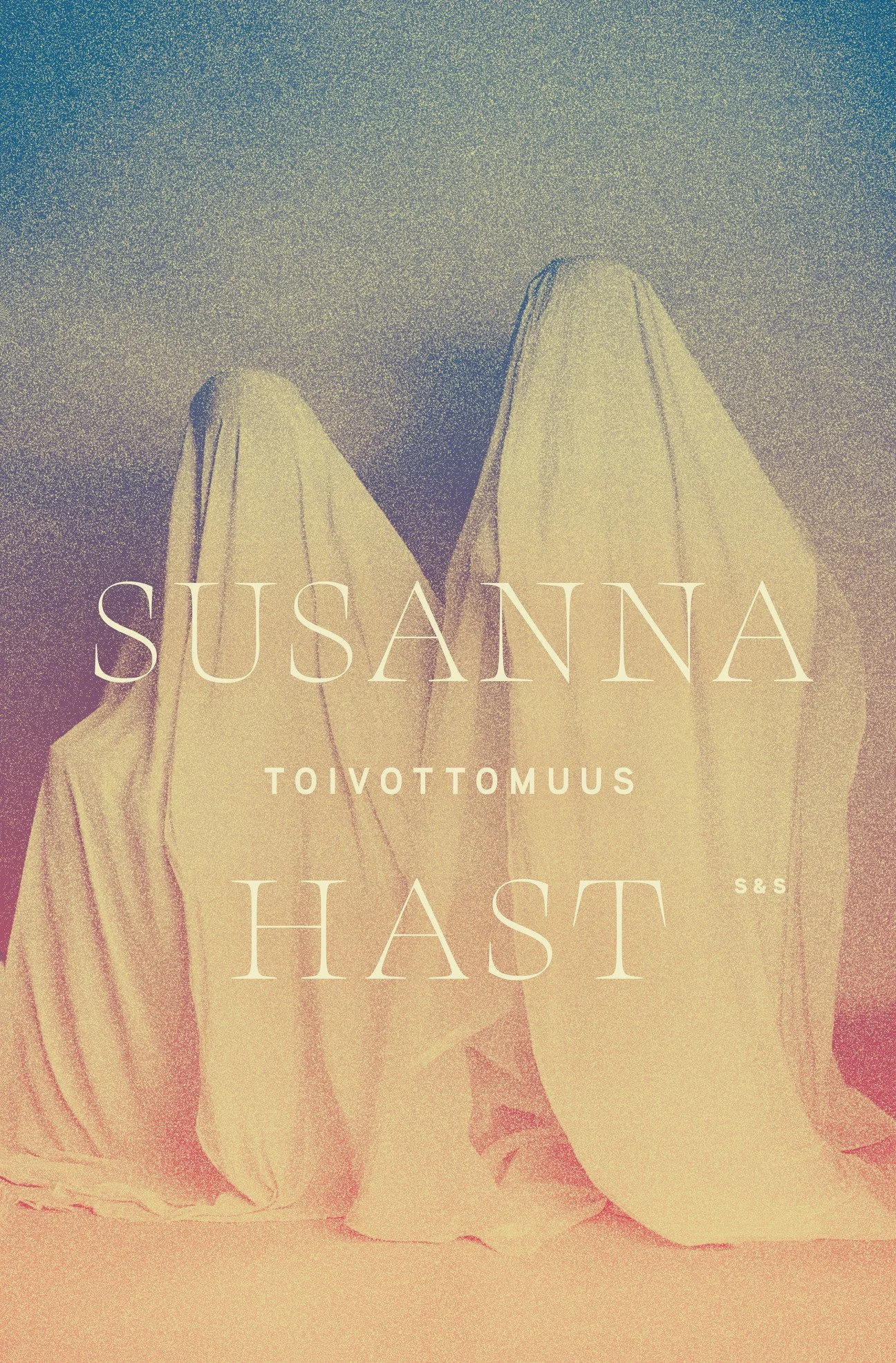
DESPAIR
SUSANNA HAST
Shortlisted for the European Union Prize for Literature 2026
Nominated for the Runeberg Prize 2025
Nominated for the Toisinkoinen Literature Prize for Best Second Novel 2025
An adult daughter lies in an empty bathtub. She has just called her mother to wish her a happy Mother's Day. Their relationship resembles a competition – whoever first calls or shows any need for the other has lost. By making the call, the daughter has admitted defeat.
During the conversation, the mother drops a verbal bomb that sends the daughter spiralling into self-doubt and paranoia. A door to the unconscious flies open and remains violently ajar. Something else has happened too: the family has been evicted from the mansion flat they rented through a friend – a friend who has now disappeared behind closed doors. Two abandonments at once. The daughter retreats into the cold, empty bathtub, where she can become small, as if back in the womb, and begins to think.
Despair unfolds in three parts. In the first, the narrator analyses her losses from the bathtub – home, friendship and mother – tracing them all back to the violence of inheritance and family. In the second, she makes a video call to her philosopher friend M, and together they mine the unconscious, reimagine the mother as a body without organs, and discover a fragile freedom in abstract thought. In the third, all institutions have begun to collapse. The narrator drives north in extreme winter conditions to find her mother – through snow, through the undead, through the horror of the double – and finally reaches the confrontation she has spent her whole life approaching.
Despair dives deep into the unconscious and casts the institution of the family – and the concepts that hold it together: inheritance, gift, father, mother – in a merciless light. Drawing on psychoanalysis and the thinking of Marguerite Duras, Luce Irigaray and Gilles Deleuze, it approaches the inherent violence of intimate relationships, the necessity of separation, and the horror of the doppelganger. Bold, original and completely unconstrained – it is a novel that burns from beginning to end.
ORIGINAL TITLE: Toivottomuus
YEAR OF PUBLICATION: 2025
PUBLISHER: S&S
PAGES/WORDCOUNT: 222 pages
READING MATERIAL: Finnish edition, English synopsis, English sample
Rights sold
Finland: S&S
Film/Tv rights
Available
PRAISE
“Hast writes world-class literature, comparable to Marguerite Duras or Clarice Lispector. From the pages of Despair I read densely thought, profound and emotionally true sentences.”
SUOMEN KUVALEHTI
“Despair grips and jolts. Its message, for all its turbulence, is clear: it is possible to choose oneself over one's mother.”
HELSINGIN SANOMAT
“Hast is a bold and experimental narrator who uses theory as the kindling for her storytelling.”
KALEVA
“A bold reach toward the surrealist canon of world literature. [...] one of the most compelling works of the year.”
TOISINKOINEN LITERATURE PRIZE, JURY STATEMENT
“Its stylistic courage, psychological acuity and ability to transform private pain into a wider cultural question make it a strong representative of a renewing and forward-looking European literary fiction.”
EUROPEAN UNION PRIZE FOR LITERATURE, JURY STATEMENT
“Despair is at the same time the most unpleasant and most satisfying reading experience. It is trauma literature marked by the compulsion to repeat – theoretically brave and artistically determined. [...] Despair refuses a solution, a climax, or setting the reader free into the external world unharmed. What a political potential is loaded in this act.”
RUNEBERG PRIZE COMMITTEE